
Faith Ward interviewed by Manish Koirala for Dungeons of Science
Dungeons of Science, is a newsletter featuring interviews, news, features, and profiles with leading climate and environmental scientists, as well as policymakers, industry leaders, and experts driving real-world climate action produced by Manish Koirala, a Science Journalist based in Bāgmatī, Nepal. Access the full interview and other articles at https://dungeonsofscience.substack.com/.
The interview opens with the context of Brunel's closure, driven by the UK government's pension consolidation agenda, which is reducing eight LGPS asset pools to six with Brunel's assets being redistributed across three of those pools. When asked about wearing many hats, Faith explains how she manages her multiple roles by leveraging their strong synergies. The work of the IIGCC and the Transition Finance Council intersects directly with Brunel's own climate strategy, particularly in encouraging financial flows into hard to abate sectors. Brunel remains her primary obligation under fiduciary duty to its partner funds, with the other roles serving to amplify and deliver that strategy at a wider scale. When acting as Chair of the IIGCC, she holds separate obligations to act in the best interests of its members, and she is careful to signal which role she is speaking from when views might diverge, prefacing answers with phrases such as "speaking as Chair of IIGCC" or "speaking from Brunel." She notes that the organisations hold complementary but not identical views, and that workloads peak and trough at different times. She acknowledges this navigation is often subconscious.
On investment frameworks, she describes the TPI as essentially a transparency tool: it assesses whether the companies with the biggest climate impact are doing what they say they will do and whether their pathway is credible. She defends Brunel's Paris-aligned investment approach despite short-term market underperformance, arguing there is a market failure in the mispricing of climate risk within mainstream indices. Paris-aligned indices are not a perfect solution, but they are a useful mechanism for correcting that mispricing. Brunel does not react to short-term underperformance by changing managers or strategy, because it views its approach as consistent with a more holistic, longer-term understanding of fiduciary duty, one that captures risks the market itself is currently not pricing in.
On greenwashing, she explains that NZIF 2.0 guards against it by moving beyond carbon accounting alone. Rather than focusing on financed emissions or the climate intensity of a portfolio at a single point in time, the framework shifts attention to forward-looking alignment: how a company aligns with its sector pathway and its direction of travel. Backward-looking metrics can be distorted by currency risk, profit margins, revenues, and other dynamics, making them potentially misleading when considered in isolation. By surfacing issues across multiple dimensions simultaneously, NZIF makes it harder for companies to obscure poor performance through accounting mechanisms. Faith notes that these frameworks are still evolving and will continue to improve.
Regarding engagement versus divestment, Faith is candid about the difficulty of attributing corporate change to specific investors, describing it as a question that vexes the industry. Brunel uses tools like Climate Action 100+ and management quality frameworks as starting points for assessing how companies are progressing on climate governance indicators. Improved transparency and decision-making at a company level is itself treated as an engagement outcome. Divestment remains part of the toolkit and is deployed selectively when companies are not progressing in a manner consistent with the risks they present to the portfolio, but Brunel avoids blanket exclusions of whole sectors. She uses mining as an example: an industry facing real decarbonisation challenges in its own operations, yet one that produces commodities essential to the net zero transition in other sectors.
On Scope 3 data, she stops short of calling anything a hard red line, but is clear that investment managers must conduct their own full value chain analysis rather than relying on currently unreliable reported data. For some companies, Scope 3 can represent 80% of climate impact, making this non-negotiable. She expects the same rigour to be applied to human rights, nature, and other material systemic risks, and requires managers to communicate their assessments clearly and back them with evidence.
On scaling transition finance into heavy industry, she identifies the absence of a shared definition of "credible" transition finance as the primary barrier. Without a common baseline, institutions cannot allocate capital with confidence. The Transition Finance Council is addressing this through guidance designed to work across asset classes, including banks' lending, insurers' underwriting, and asset managers' activities, anchored by sector pathways that reflect the fact that credibility varies by sector and country. Co-created sector transition plans, with finance embedded in their development, are a further component.
On nature-related reporting under the UK's Sustainability Disclosure Requirements, she draws a pointed contrast with climate reporting. Climate benefits from a consistent unit of measure in CO₂ equivalents that can be applied across sectors and geographies. Nature is place-based and multifaceted, so the relativity of risk shifts in every context. The technical gap is making nature risks measurable and comparable at scale. She also cautions against over-reliance on quantification, stressing that qualitative narrative remains essential to avoid unintended consequences and to understand where a company is genuinely heading.
Faith advocates for reforming how investment time horizons are defined in regulation, arguing that for defined benefit funds moving toward buyout, current rules can be interpreted as constraining the relevant timeframe to the instrument rather than to the lifetimes of the beneficiaries themselves. She recommends that guidance to trustees be revised to reflect beneficiary demographics instead.
On AI, Brunel uses it for stewardship analysis, including examining voting records of asset managers to identify trends, as well as for communications and research. She urges care, noting the risk of hallucination, and flags that AI's energy consumption and cooling requirements make it a responsible investment theme in its own right.
Her career advice to those entering sustainable finance is to resist the pressure to know everything across an enormously broad field, and instead to develop deep expertise in one area while building a strong, diverse network spanning scientists, actuaries, accountants, and policymakers. Think of yourself, she says, as a sponge: absorbing information across disciplines and translating it into a financial context.
She closes with a firm conviction that sustainable finance is not optional. Regardless of short-term macroeconomic and political headwinds, it is a fundamental imperative for building a resilient economy that delivers jobs, energy security, and long-term wellbeing for society. Those challenges, she argues, will ultimately make the field more robust by forcing a return to sound fundamentals and authentic, evidence-based practice.
More information about the author at https://www.linkedin.com/in/manishkoirala1/
© 2026 Manish Koirala
Related reading
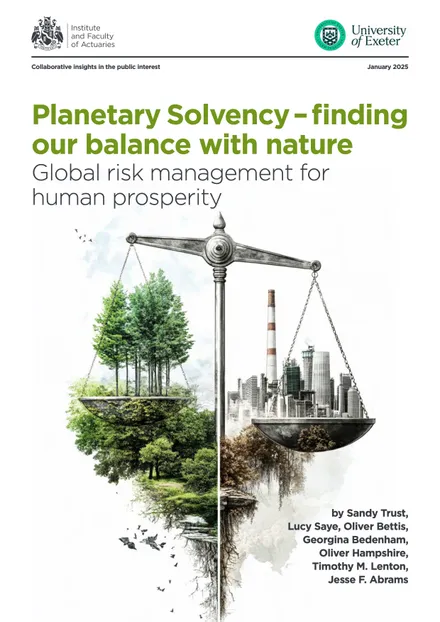
Highlighting the latest in a series of reports raising awareness of the financial impacts of system-level risks, this one focusing on the role of nature and related food systems risks, that make for essential reading for all asset owners, policy makers and others in the investment industry.
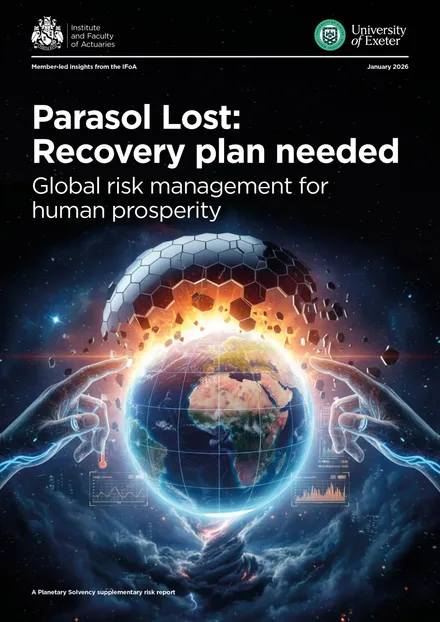
Faith Ward highlights investor responsibility and need for policymaker focus at planetary solvency report launch
This article is published under the following licence:
Terms of Use
See the Faith in RI terms of use on how this work can be used.
Read licence →